David Kurtz / technology strategy & automation
Systems thinking.
Practical automation.
Turning IT challenges into systems that run faster, cost less and hold up under pressure.
Three projects, each starting from a business problem: scattered project context, manual patching, and an unproven platform.
COHORT
Accountable multi-agent coding.
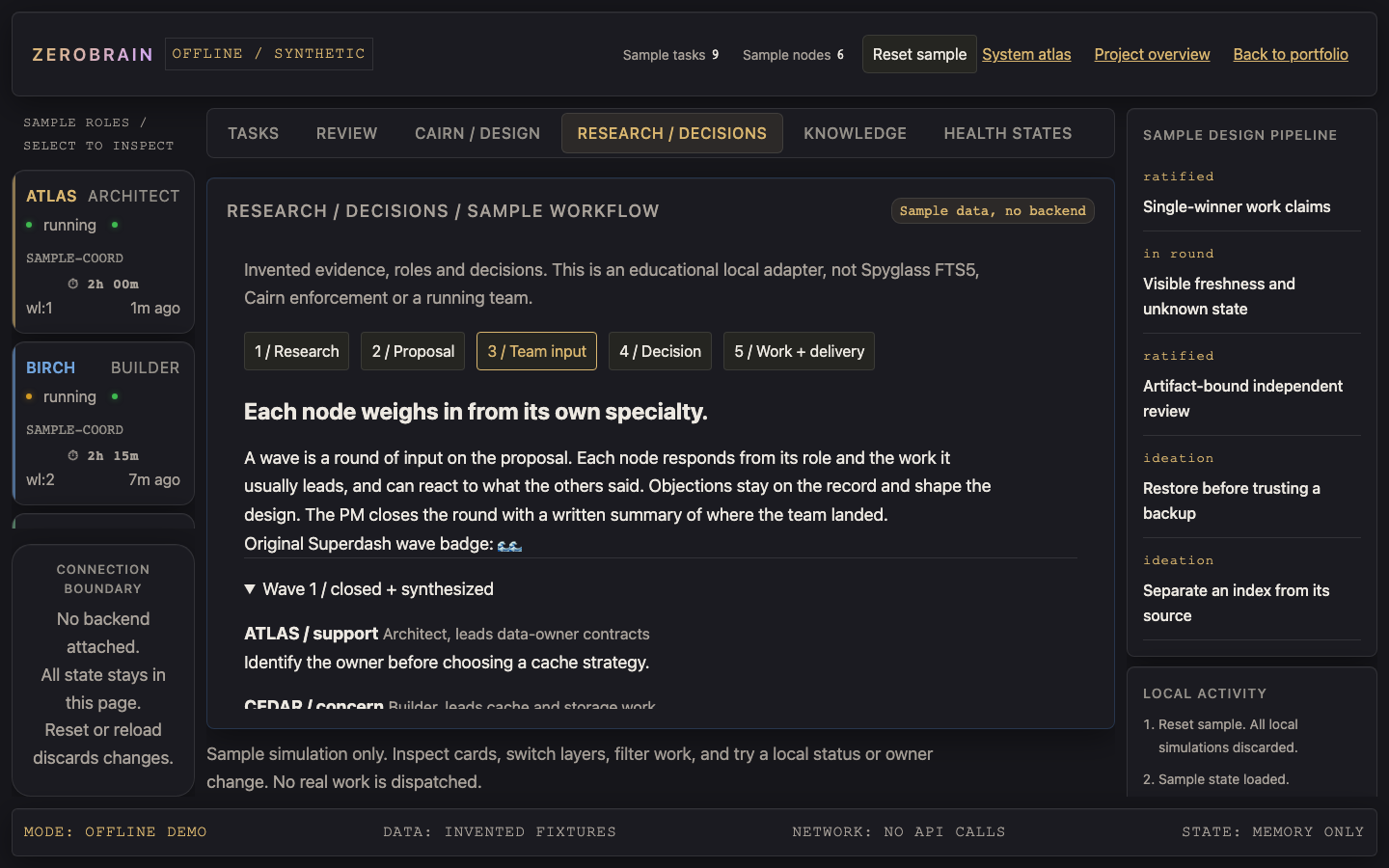
Run enough projects at once and context starts slipping between them. I built COHORT's agent-coordination functions to organize my own projects and tasks. Its design connects goals, workflow decomposition, distinct role perspectives, research, decisions, and accountable handoffs. The ZeroBrain dashboard makes that work visible.
Reliable by design. The goal is a personal engineering team: distinct role perspectives connected by shared goals and workflows, explicit ownership, review of exact artifacts, and durable context across handoffs. Unknowns and failures stay visible, so reliability can be checked at any time.
The atlas maps 37 documented systems and boundaries: roles, inputs and outputs, authority, handoffs, runtime availability, and source evidence.
The system
- OwnershipWork claims, context, and visible failure.
- ReviewArtifact-bound review and design layers.
- SurfaceFunctional ZeroBrain dashboard/frontend.
Inspect the project
Explore the workflow
Try the workflow and explore the technical architecture and source references in the repository.
- Explore
- Task, node, review, design, and knowledge views, plus the research/decisions inspector, with filters and drilldowns.
- Decide
- On a design proposal, each node weighs in from its role and the projects it usually leads. Their input and objections shape the design. The PM's summary of each round carries the most weight, and I have the final say on when it's ready to build.
- Separate
- RFC council-vessel recusal and independent artifact review serve different review responsibilities.
- Try
- Explore status and owner changes, deadlines, and health states in the sample workflow; reset to start again.
- Discuss
- Work ownership, artifact-bound review, durable-context architecture, and visible failure.
ANS-CHOCO
Policy-driven software alignment, with evidence.
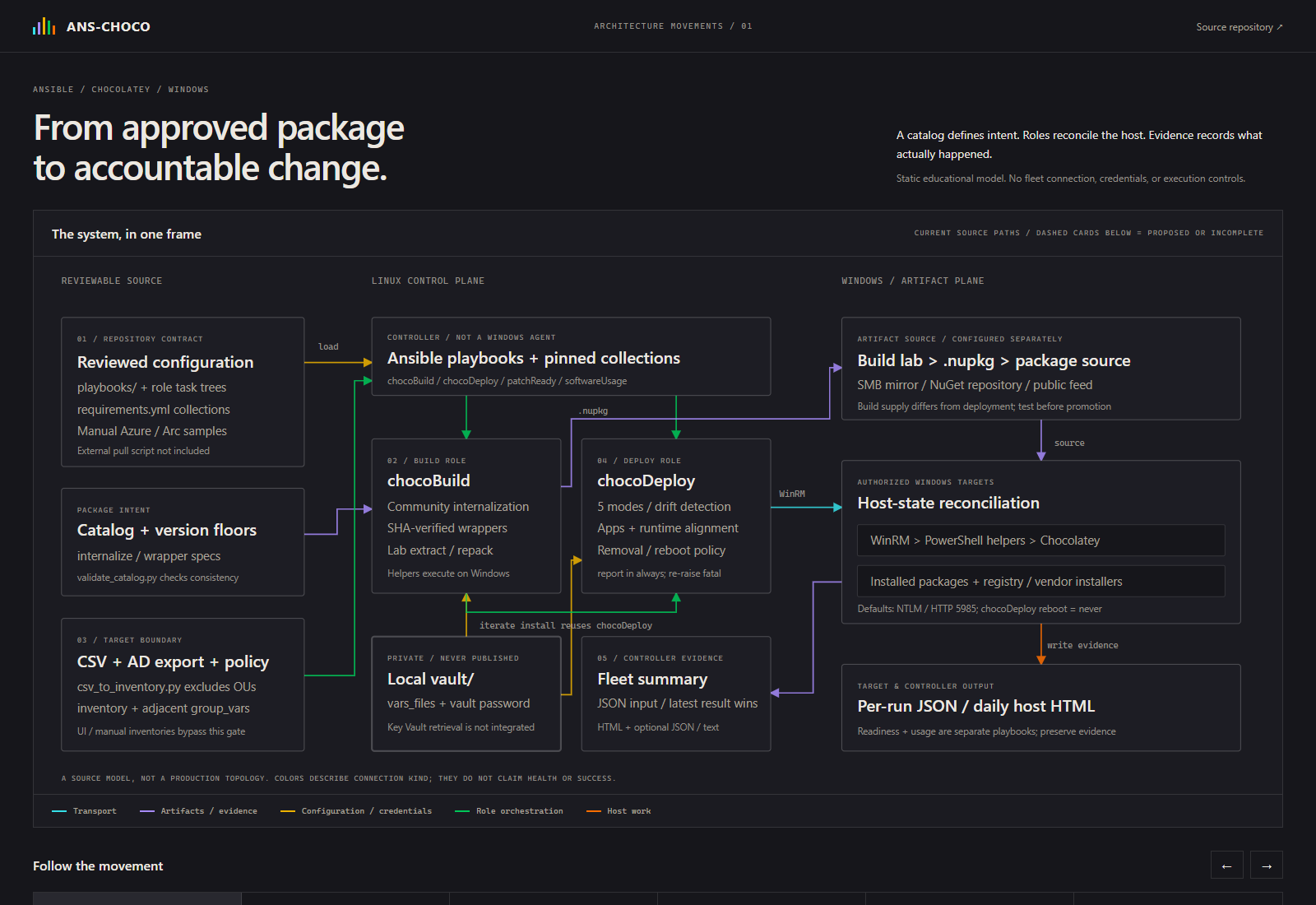
Keeping Windows software current across a fleet usually means manual installs and no record of what landed where. ANS-CHOCO handles policy-driven Windows software alignment with Ansible and Chocolatey, from reviewed package intent to per-host deployment evidence. Its source-grounded architecture showcase follows catalog validation, inventory, package build and deployment, reconciliation, and reporting.
The system
- IntentReviewed catalog and version-floor policy.
- AlignmentAnsible, WinRM, and Chocolatey.
- EvidencePer-host results and fleet reporting.
Workflow in context
Follow reviewed policy through package preparation, host alignment, and reporting evidence. Configure targets, package sources, and authentication to apply the workflow in your environment.
Inspect the pipeline
Delivered scope and operational design
The pipeline connects reviewed package intent to host alignment and deployment evidence, with separate build and deploy roles and explicit operational policy.
- Delivered
- Catalog and version-floor validation, CSV and AD protected-OU inventory preparation, community and wrapper package builds, five application deployment modes, runtime alignment, WinRM/PowerShell/Chocolatey reconciliation, and per-host JSON/HTML plus fleet reporting.
- Architecture
- Modular build and deploy roles separate package preparation from fleet execution. A shared catalog and version-floor policy connect reviewed intent, package sources, and host alignment.
- Operations
- Reboots default to never, with explicit operator policy. Per-host outcomes, failed-attempt and retry evidence, and fleet summaries keep maintenance decisions grounded in what happened. See the repository for setup and detailed execution boundaries.
- Portability
- Package catalogs and policy, inventories, package sources, and authentication are configurable, so the workflow moves to any lab. Execution currently uses Ansible and WinRM. As deployment scale, business scope, and security requirements evolve, future enhancement options include Azure Arc execution through official modules and client-based authentication, with the aim of reducing reliance on WinRM.
Explore the architecture to see how policy, package preparation, host alignment, and evidence fit into one operational workflow.
Azure Local POC
Six-node ambition. Resource-aware engineering.
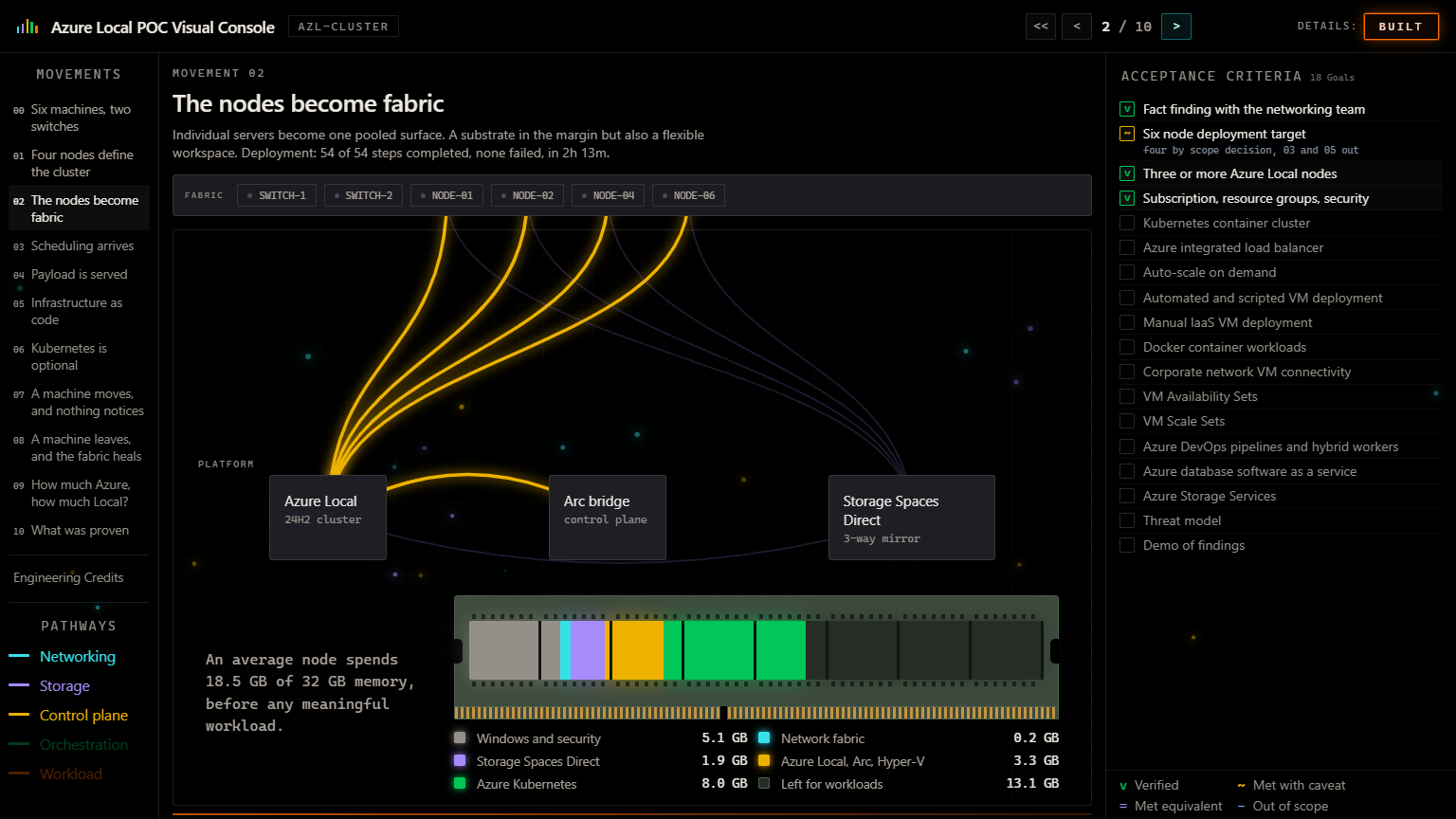
Hybrid platforms are hard to understand from the hardware up. An initial six-node Azure Local cluster goal became a resource-aware design exercise using available lab hardware. The delivered four-node POC connects physical fabric, pooled storage, Arc management, Kubernetes, and workloads, with the capstone showing the engineering choices behind the working platform.
The system
- FoundationPhysical fabric and pooled storage.
- PlatformAzure Local, Storage Spaces Direct, and Arc.
- WorkloadsAKS Arc, guest workloads, and VM lifecycle.
Engineering in view
Follow physical fabric, pooled storage, Azure management, and workloads through an interactive walkthrough of recorded lab engineering.
Inspect the design
Recorded engineering, explained interactively
Progressive movements reveal subsystem relationships; evidence cutaways explain the retained engineering records.
- Recorded
- Cluster and pooled storage, Arc bridge, guest workloads, AKS application behavior, and operator-driven Terraform VM lifecycle.
- Design
- The lab design makes infrastructure dependencies, memory constraints, and deployment choices visible through recorded evidence.
- Apply
- Adapt the provisioning examples to your Azure tenant/subscription, permissions, prepared hardware, directory services, networking, and credentials.
Make the system understandable.
Three projects, three useful lenses for a technical conversation.
Coordination
Keep context visible.
How agents communicate, plan work, and navigate a shared project surface.
Repeatability
Connect the workflow.
How application patching brings automation, fleet context, and reporting together.
Relationships
Explain the whole stack.
How infrastructure subsystems connect hardware to an orchestration environment.
Let's talk systems.
For conversations about automation, infrastructure, and the work here, find me on GitHub.